coiffeur › Good to know › Coily and curly hair: the routine, the braids, the cut
Coily and curly hair: the routine, the braids, the cut
Porosity rather than curl classification, wet detangling, the order products go on, protective styles and the dry cut: the practices that never appear in general hair advice.
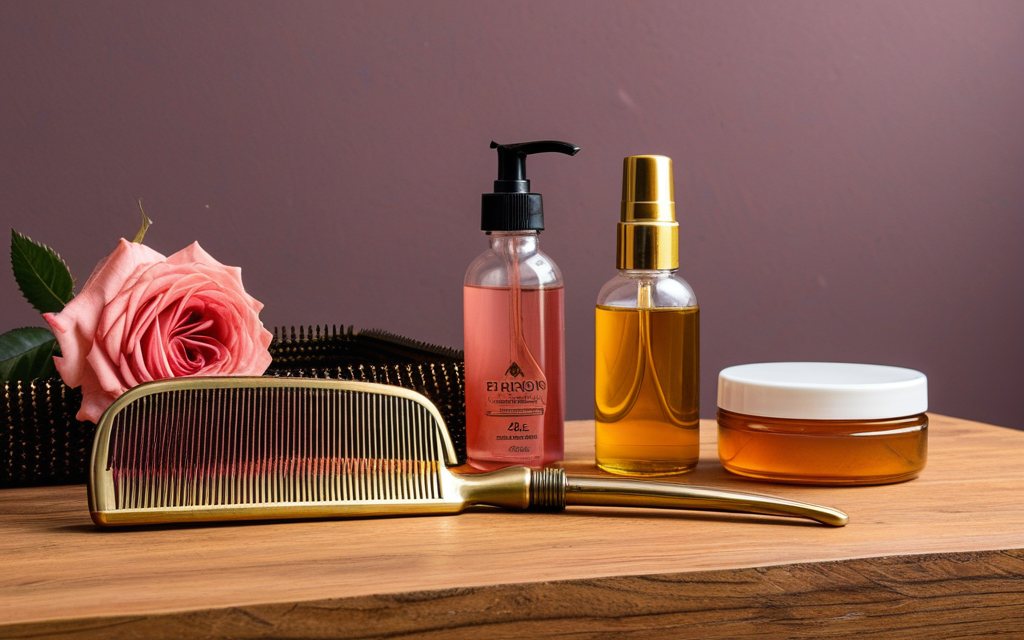
Coily and curly hair is the majority in a good part of the Casablanca clientele, and yet most hair advice treats it as a special case. Above all it is hair whose shape — the strand is elliptical and coils around itself — creates bends that are more fragile. Everything that follows comes from that.
Forget the number, look at the porosity
Classifications like 3a, 4c and the rest are useful for arguing on social media, not for choosing a product. The parameter that matters is porosity: how fast the hair takes water in, and how fast it loses it again.
Low-porosity hair takes a long time to get wet and repels products, which sit on the surface: it needs heat to drive a treatment in — a warm towel, a cap, or simply the shower. High-porosity hair drinks everything, dries fast and is dry again within the day: it needs the moisture sealed in with something richer.
Detangling, which decides everything
This is where length is lost, not at the salon.
- always on <b>damp</b> hair, never dry
- always with a <b>slippery product</b> in place — a detangler or a mask
- always working <b>from the ends towards the roots</b>, section by section
- fingers first, wide-tooth comb afterwards
- four to eight sections held with clips: the work goes faster and you break less hair
Moisture, in the right order
Water is what moisturises; everything else stops the water leaving. Hence the sequence: wet hair, then a water-based leave-in, then an oil or a butter to seal, then a styling cream if you want one. Reverse the order and you are oiling dry hair, which makes it shine without moisturising it.
Washing: a mild shampoo, or a co-wash, once a week to once every ten days depending on the scalp, how active you are and the season. A clarifying shampoo once a month to take out the limescale and the product build-up — in Casablanca that step is not optional.
Protective styles
Braids, box braids, cornrows, twists, weaves, wigs and locs: all of them rest on the same idea, putting the ends out of harm's way for a few weeks. They genuinely protect, on three conditions.
<b>It must not pull.</b> A braid that hurts, that lifts the skin or that leaves little white bumps at the root is too tight. Repeated tension thins the temples and the hairline, and that kind of loss is not always reversible. Say so while it is being done, not three days later: a professional braider will loosen it without argument.
<b>It cannot be kept in indefinitely.</b> Six to eight weeks is the limit commonly advised. Beyond that the new growth pulls, the knots fuse together and taking the style out breaks hair.
<b>Taking it out matters as much as putting it in.</b> It is done with a slippery product, section by section, without pulling, and it takes time. You wash, detangle and do a deep treatment before putting anything back in — and not on the same day.
Relaxers and going back to natural
A relaxer permanently breaks the structure of the hair: the relaxed part will not become coily again, it will grow back coily at the root. The line where the two textures meet is the weak point, and that is where hair snaps during a transition.
Two routes, both of them valid: cut it short in one go, or keep the length and trim gradually over a year or two while looking after the join. Either way, no strong heat, and styles that even out the two textures — twists, rope twists, braids — so you can get through the period without a fight every morning.
The cut, and why it is done dry
Coily and very curly hair shrinks a great deal as it dries. Cut wet, the dry result no longer has the shape that was intended. That is why salons specialising in curls cut dry, curl by curl, and why the service costs more than an ordinary trim: it takes longer.
Where to go in Casablanca
Specialist salons do exist, and they are not all in the same districts. Maârif has both afro salons and a curl bar that works dry. There are also afro salons in Bourgogne and towards El Hank, in Riad Oulfa, and on Boulevard Mohammed V. In the old medina, around Bab Marrakech, sub-Saharan hairdressers work without a fixed salon at rates well below those of the beauty institutes — a report in the Moroccan press in January 2023 mentioned a ratio of four to five times.
Prices, and what makes them
In October 2026 an afro salon in Maârif listed braids from 300 DH and cornrows from 50 DH; a barber in Racine listed a relaxer at 250 DH. Those figures are starting points, and the gap up to the final price comes from:
- the <b>length</b> you want, and whether the extension hair is supplied by the salon or by you
- the <b>fineness and the number</b> of braids: micro-braids mean hours more work
- the <b>number of hairdressers</b>: four hands is faster and dearer
- the <b>technique</b>: cornrows, crochet, a sewn-in or a glued-in weave do not take the same amount of time
- the <b>treatment</b> before or after, often billed separately
Ask for the total before you sit down, and ask how many hours it is supposed to take. For this kind of service the hour is the real unit, even when it is not the one on the price list.
Need a professional in Casablanca?
One request, and the relevant professionals get back to you.
Describe what I am looking for